Appearance

Visual style

Mode
Theme
Accent
Advanced
Text sizeScales the whole site
16 px
Reduce motionReduce animations or match your system
Separate light and darkChoose a theme, accent and font for each
50

Where I work · Ekonavi · Brazil

Funding the farmers who bring land back to life.

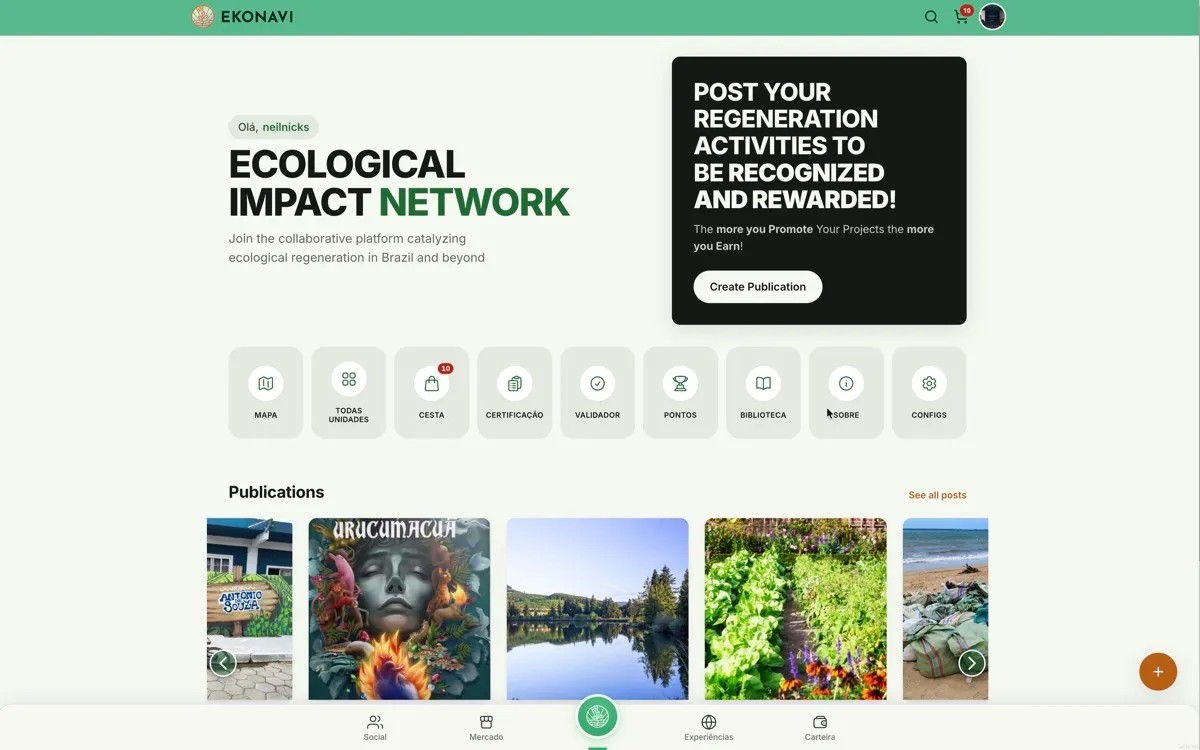
Ekonavi is a Brazilian network that records regenerative farming, gets it independently verified, and turns that proof into something buyers and investors can fund.

My roleFull-Stack Developer & DevOps Engineer on the Ekonavi team since 2024. I build the platform's apps, APIs and delivery pipeline.
G20 · BIS · Banco Central do Brasil Winner, G20 TechSprint 2024 Nature-based solutions category, out of a record 110 proposals worldwide Read the BIS announcement ↗
  1. 01

    Farmers record the work

    Planting, agroforestry and soil care go into a public field diary, with photos and a place on the map.

  2. 02

    Independent checks prove it

    Verifiers visit, valuators measure the impact, and a certifier issues a certificate anyone can check.

  3. 03

    Proof turns into funding

    Verified impact becomes something buyers, supporters and investors can pay for, and the money reaches the land.

The problem

Regenerating land is slow, hard work. Getting paid for it is harder.

  • The work goes unseen

    Small farmers restoring forest and soil rarely have a way to show what they have done, so their effort stays invisible to anyone who might pay for it.

  • Impact is hard to prove

    Measuring trees, biomass and soil health usually needs expensive audits. Without proof, regenerated land is worth no more than degraded land.

  • Money stops before the land

    Funding for nature tends to pass through intermediaries. The people doing the planting see little of it, and supporters can't see where it went.

How it works

From a farmer's field diary to a certificate anyone can check

Every claim passes through people with different jobs, so no one checks their own work. The final certificate is recorded on a blockchain, which means it can't be quietly changed later.

  1. 1 Producer Registers a project and reports field activity
  2. 2 Verifier Inspects on the ground and confirms the practices
  3. 3 Valuator Calculates the environmental and financial impact
  4. 4 Certifier Issues a certificate, recorded on a blockchain
  5. 5 Funders & public Buy, support or audit it on the public dashboard

Source: Ekonavi ecosystem documentation ↗

My role · since 2024

Two years building Ekonavi

I joined Ekonavi in 2024 and I'm still on the team. I work across the whole stack: the Next.js apps people use, the APIs behind them, the shared code they all depend on, and the pipeline that ships it. Anyone using Ekonavi today passes through code I've written or maintain: the shared sign-in, header and uploader appear in every app.

  • Platform

    9 apps, one codebase

    A pnpm and Turborepo monorepo holding nine production apps, all deployed on Cloudflare Workers.

  • Every app

    Shared packages

    Auth, header, footer, uploader, forms and the theme: written once and used by every Ekonavi app.

  • Marketplace

    Commerce API and payments

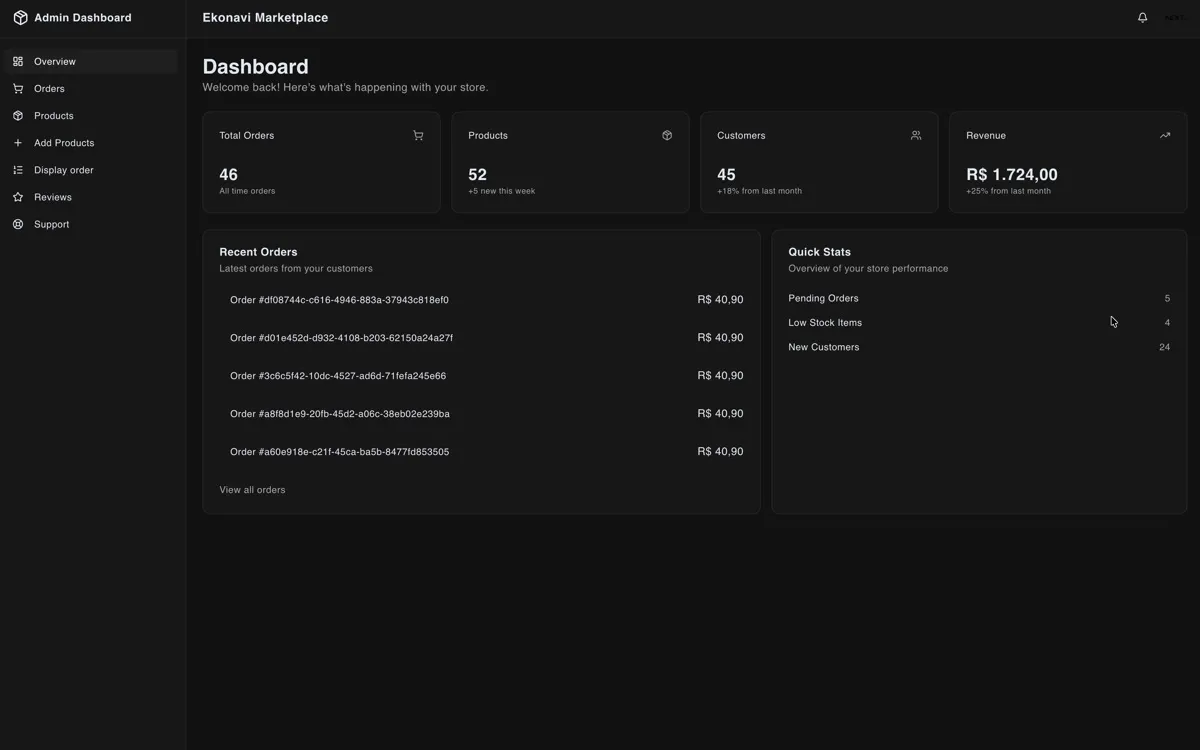
    Cart, checkout and orders for Mercado, with Mercado Pago PIX and crypto payments confirmed by webhook.

  • Marketplace

    Seller dashboard

    Where producers manage orders, stock, reviews and support for their stores.

  • Delivery

    CI/CD pipeline

    GitHub Actions builds every app, deploys to staging and promotes to production.

  • Quality

    End-to-end tests

    A Playwright suite that checks the flows crossing app boundaries, where the costly bugs live.

The engineering is written up in two case studies:

The ecosystem

More than a marketplace

The shop is one part of it. Around the same verified data sit a community map, a field diary, certification, a public dashboard and an open API.

Shared, verified data Ekonavi
  • Map & community

    A social network that puts ecological producers, projects and planting days (mutirões) on a map.

  • Field diary & points

    Producers log activities and earn rewards for documenting and promoting them.

  • Certification

    The producer, verifier, valuator and certifier workflow behind every certificate.

  • Marketplace

    Mercado, where products from regenerative producers are sold, with PIX payments.

  • Public dashboard

    ESG metrics and aggregates anyone can inspect, so claims can be checked.

  • API & docs

    A documented API so other platforms and developers can plug into the data.

Recognition

Chosen by the G20, tested by Brazil's own institutions

1stof 110 proposals

Award

G20 TechSprint 2024, winner

Won the nature-based solutions challenge of the G20 global hackathon, run by the BIS Innovation Hub and Brazil's central bank (Banco Central do Brasil) under Brazil's G20 presidency. The winning solution turns data from verified restoration projects into investable assets aligned with international ESG standards.

BIS announcement ↗ Winner video ↗

  • Government

    Federal government Web3 hackathon, finalist

    Finalist in the Brazilian federal government's hackathon on tokenising the National Treasury (Tesouro Nacional), December 2023, with the Blockteam team.

    Source ↗
  • Competition

    Mercado Bitcoin "Tokenize sua Ideia", finalist

    Finalist in the 2023 tokenisation competition run by the Brazilian exchange Mercado Bitcoin.

    Source ↗
  • Press

    Featured in MIT Technology Review

    Covered by MIT Technology Review in May 2023.

    Source ↗
  • Partners

    Regen Network and IXO

    Partnerships that brought on-chain records to the platform, cited as one of the first cases of blockchain financing for agroforestry and land restoration.

    Source ↗
  • Programmes

    Startupbootcamp and XRPL Commons

    Joining the Startupbootcamp accelerator and the XRPL Commons programme.

    Source ↗

Milestones

From a documentary to a G20 win

  1. 2019

    The documentary O Elo Perdido, by Breno Veiga and Simão Luling, is released. Ekonavi grows out of it.

  2. Dec 2020

    The platform launches: farms put their projects on a map and share their work and planting events.

  3. 2022–23

    Partnerships with Regen Network and IXO add blockchain records and the first token-based funding for agroforestry.

  4. 2023

    Featured in MIT Technology Review. Finalist at Mercado Bitcoin and in the federal government's Treasury tokenisation hackathon.

  5. 2024

    I join the team as full-stack developer and DevOps engineer.

  6. Nov 2024

    Wins the G20 TechSprint, chosen from 110 proposals from around the world.

  7. Now

    A full ecosystem: certification, marketplace, public dashboard and API, with work on low-cost impact measurement for farmers.

Where it works

All six Brazilian biomes

  • Amazônia
  • Caatinga
  • Cerrado
  • Mata Atlântica
  • Pampa
  • Pantanal

Regenerative pilot projects

  • Bahia
  • Minas Gerais
  • Colombia

Based in Belo Horizonte, Minas Gerais. Sources: Nova Mata ↗, Wikipedia ↗

Where it's heading

Make restored land worth more than cleared land

  • 1

    Measurement farmers can afford

    Ekonavi is developing digital measurement, reporting and verification (dMRV) for biomass on terms that favour the farmer, so proving impact stops being something only large landowners can pay for.

  • 2

    Restoration as an asset

    The G20-winning idea: once restoration is verified, its data can back assets that investors can buy, which brings mainstream finance to people planting forests.

  • 3

    Beyond Brazil

    Pilots already run in Colombia, and the model of record, verify and fund is not tied to one country or one biome.

Building something with a mission?

I build platforms, marketplaces and APIs for teams with real-world goals. Tell me what you're working on.