Appearance

Visual style

Mode
Theme
Accent
Advanced
Text sizeScales the whole site
16 px
Reduce motionReduce animations or match your system
Separate light and darkChoose a theme, accent and font for each
50

Service · Backend, Cloud Infrastructure & AI Integration

AI integration for business software

I integrate large language models into web applications as server-side features: document summarisation, assistants that answer from your own content, classification and extraction. The engineering that matters is keeping keys and prompts on the server, grounding answers in your data, limiting cost and abuse, and designing for wrong answers.

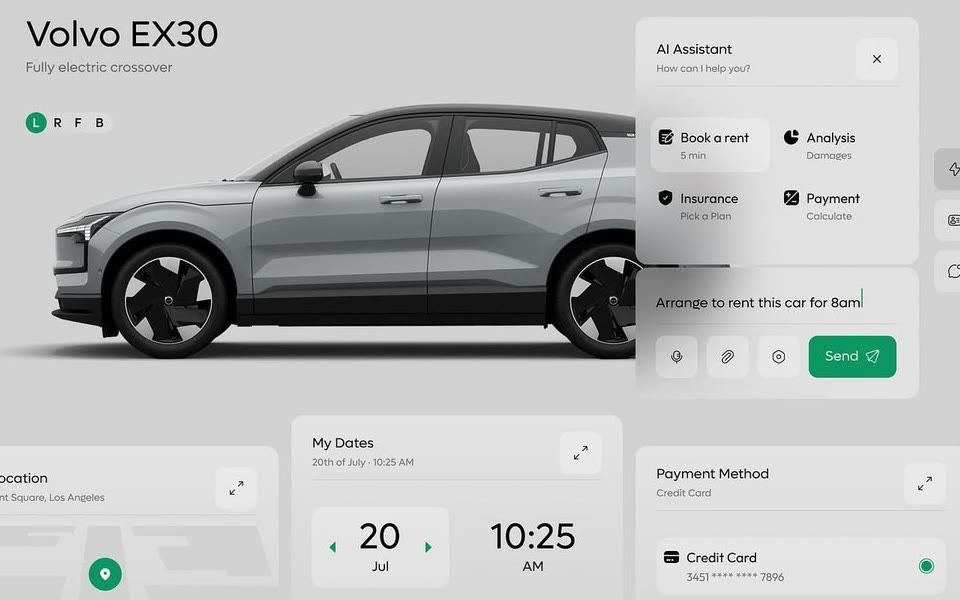
AI assistant panel beside a car listing, offering booking, damage analysis, insurance and payment
Reference · AI assistant

Who it's for

Where ai integration pays off

  • Documents nobody has time to read

    Contracts, reports or applications that need a first-pass summary or key fields extracted before a person reviews them.

  • Repeated questions

    Customers or staff asking the same questions, answerable from your own policies, products or documentation.

  • Unstructured input

    Free-text enquiries, reviews or tickets that need sorting, tagging or routing.

What's included

Capabilities and features

  • Server-side model calls

    API keys and prompts never reach the browser; requests go through your backend with authentication and logging.

  • Grounded answers

    Retrieval over your own content so answers cite sources, instead of relying on what a model happens to know.

  • Structured output

    Model output validated against a schema before it's stored or acted on.

  • Rate limits and quotas

    Per-user limits and plan-based quotas so a feature can't become an unbounded bill.

  • Human in the loop

    Review steps for anything with consequences, and clear labelling of AI-generated content.

  • Provider flexibility

    A thin adapter so you can switch between model providers as prices and quality change.

Tasks where AI features work well

AI features that last tend to do one narrow task whose output a person can check:

Good fitWhy
Summarising long documents for a human reviewerSaves time; a person still decides
Extracting fields from semi-structured filesOutput can be validated against a schema
Drafting replies from a knowledge baseGrounded in your content; a person sends
Classifying and routing incoming messagesMistakes are cheap and correctable

Poor fits are tasks where a wrong answer is expensive and hard to spot, or where a simple rule or search box would do the job.

Production requirements for LLM features

The model call itself is a few lines of code. Most of the work is around it:

  • Keys on the server only. Never expose provider keys through client-side environment variables. It’s the first thing I check in any AI codebase.
  • Validation. Parse model output with a schema; reject or retry when it doesn’t conform.
  • Limits. Rate limits per user and quotas per plan, enforced before calling the model.
  • Observability. Log prompts, latency, token usage and failures (without logging sensitive data) so cost and quality are visible.
  • Fallbacks. Time-outs and a graceful path when the provider is down.

Evidence

Zap PDF AI is a personal SaaS prototype: PDF upload and text extraction, summarisation through an LLM chat-completions API, Clerk authentication, Stripe subscription billing and a rate limiter on the analysis endpoint. Building it covered the requirements above. I don’t yet have a production AI deployment for a client.

Approach

How a ai integration project runs

  1. Pick one valuable task

    A specific, measurable job (summarise this document type, answer from this knowledge base) rather than "add AI".

  2. Prototype with real data

    Test on your actual documents and questions, and collect the failures.

  3. Engineer the guardrails

    Grounding, validation, limits, logging and a fallback when the model is wrong or unavailable.

  4. Ship and measure

    Track usage, cost per task and how often people accept or correct the output.

FAQ

AI Integration: common questions

How can AI be integrated into existing business software?

Usually as a backend feature behind an existing screen: a summarise button on a document, a suggested reply on a ticket, auto-filled fields from an uploaded file. The application sends the relevant data to a model through its own API, validates the result and shows it to the user for review.

What is retrieval-augmented generation (RAG)?

A pattern where the application first searches your own content for passages relevant to a question, then gives those passages to the model to answer from. It reduces made-up answers and lets responses cite sources. It requires keeping a searchable index of your content up to date.

Is it safe to send company data to an AI model?

It depends on the provider's data-handling terms and on what you send. I keep calls server-side, send only the data a task needs, avoid sending personal data unless necessary and agreed, and choose providers and settings that don't train on submitted data where that matters.

What AI work have you done?

My hands-on AI work so far is a PDF summarisation SaaS prototype (Next.js, an LLM chat API, Clerk authentication, Stripe subscriptions and rate limiting). It's a personal project, not a production client deployment.

Have a task that AI should take off your team's plate?

Describe the task, the data involved and how you'd judge a good result. I'll tell you whether an LLM is the right tool for it.